Calm creates commerce: Why emotion is becoming airports’ strongest revenue driver

Across the global airport industry, a quiet tension is emerging. Passenger volumes are recovering and growing, commercial investments are increasing, yet non-aeronautical revenue per passenger is not keeping pace. For years, the response has been to optimise the commercial layer: more concepts, sharper pricing, better promotions. But these interventions are not always delivering the anticipated commercial uplift.
The reason is simple. Airports have been optimising what passengers encounter, but not how they feel when they encounter it. And that distinction is now becoming critical.
The latest ACI Global Traveller Survey points to a structural shift: wellbeing, comfort and emotional engagement are no longer differentiators. They are baseline expectations. Airports that meet them see disproportionate gains in both satisfaction and spend. The implication is clear: the path to commercial growth does not start in retail. The path starts in psychology.
Why feelings outperform features
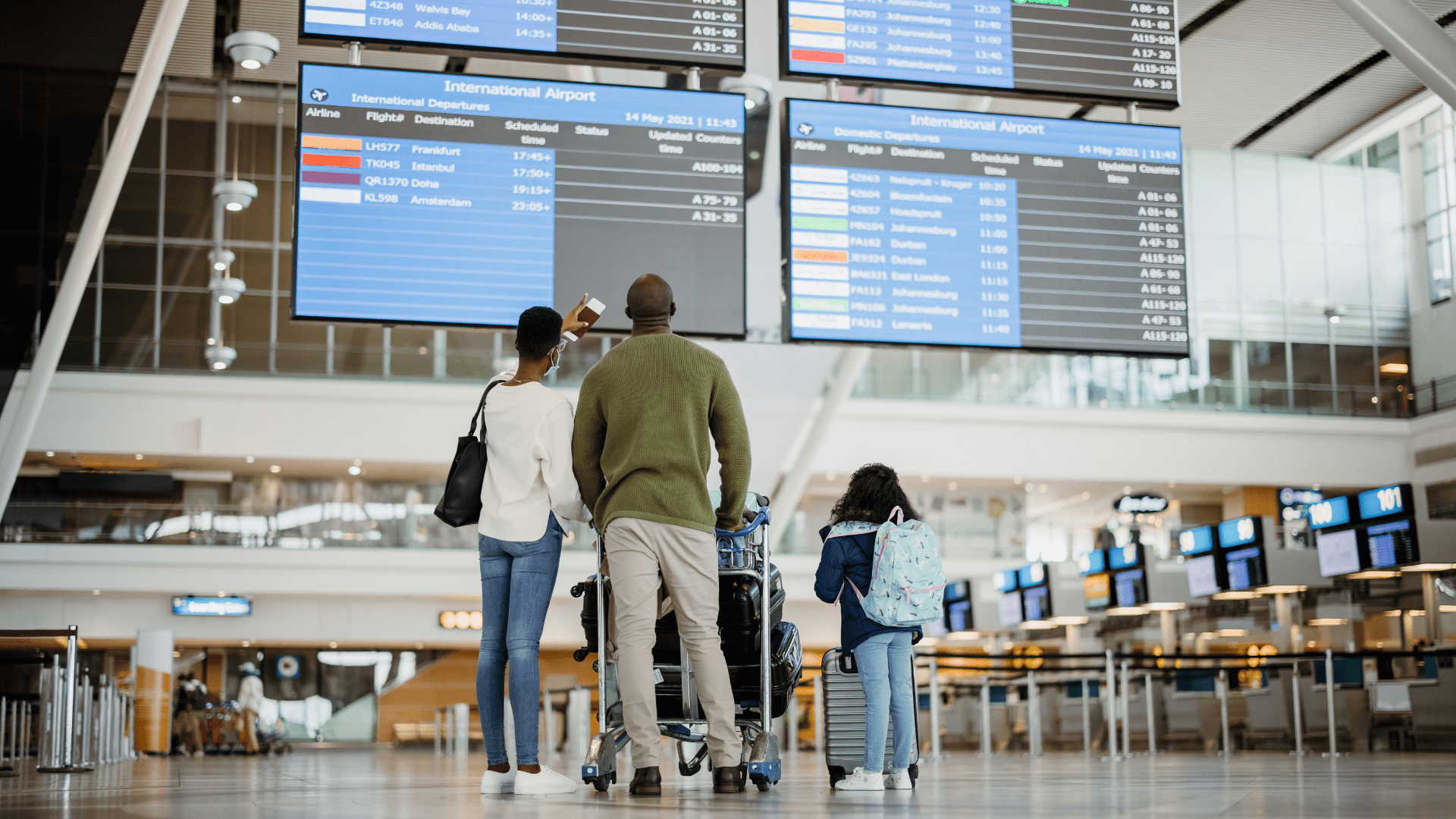
Airports have made significant progress in improving processes. Security is faster. Information is more available. Operations are more efficient. Yet a substantial share of passengers still experiences stress, particularly in the early and pre-boarding stages of the journey.
This matters more than it may seem. When people feel uncertain, they instinctively narrow their focus. Their attention becomes guarded. Their behaviour becomes task -oriented. Time is no longer something to enjoy, but something to manage. In that state, commercial environments lose their power. Retail and food & beverage are no longer explored. They are approached transactionally, often as a matter of convenience or precaution.
This is where many commercial strategies fall short. They attempt to influence behaviour at the point of sale, while the underlying emotional conditions for spending have already been compromised. Conversely, when the journey feels predictable and reassuring, something shifts. Passengers regain a sense of control, cognitive load decreases, and attention expands. With that expansion comes openness to browse, to discover and to engage.
The data reinforces this behavioural link. Across markets, satisfaction correlates strongly with elements that reduce stress and increase comfort, suggesting that human-centred design is not just experiential, but economically consequential.
The revenue logic of removing anxiety early
Commercial performance in airports is often treated as an outcome of retail strategy. While in reality, it is an outcome of psychological readiness.
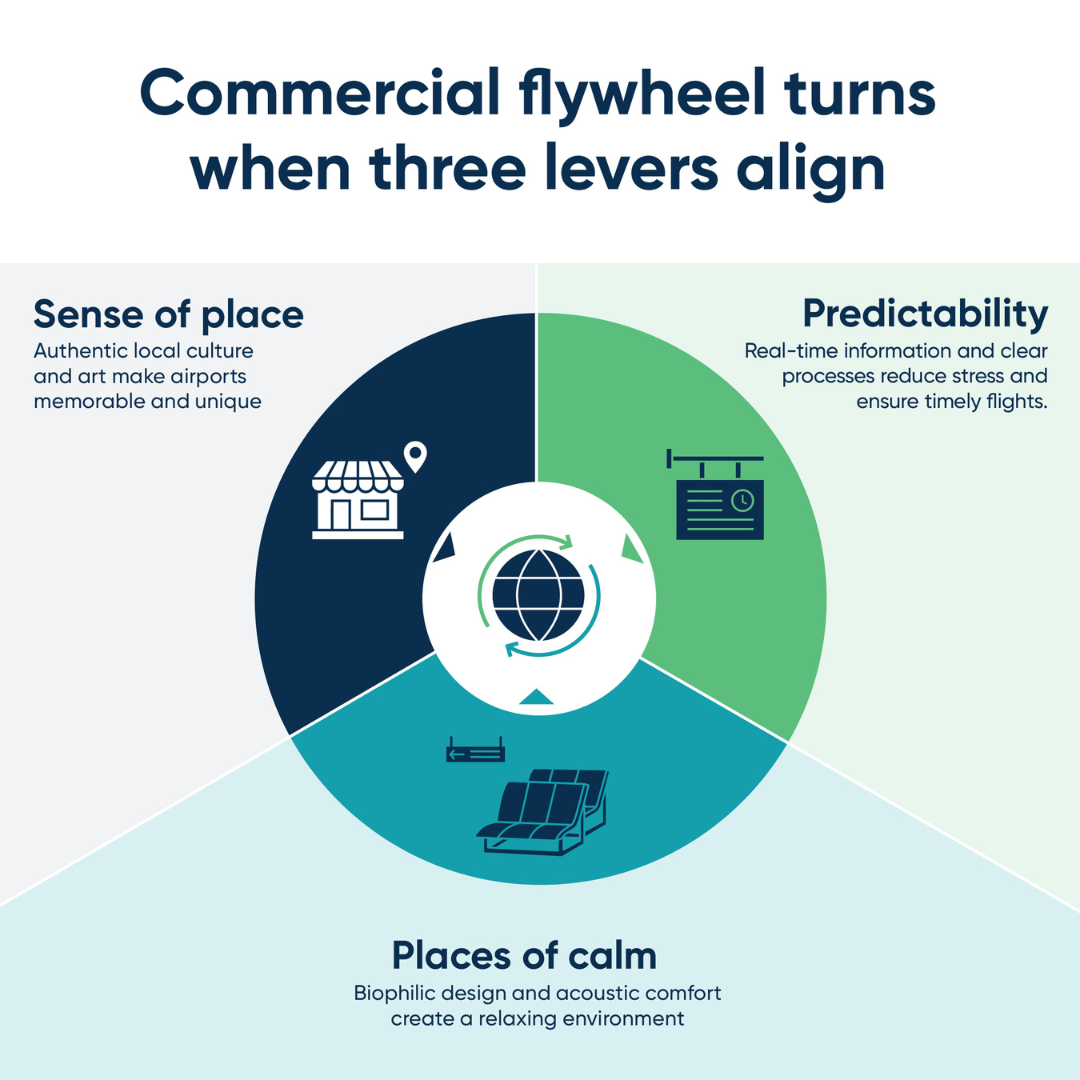
That readiness is shaped by three interdependent levers:
1) Predictability: Knowing what happens next
At its core, the airport journey is defined by uncertainty. Time pressure, unfamiliar processes and fragmented information all contribute to cognitive load. The first promise passengers seek is reassurance: I will make my flight. Deliver that promise early and consistently, and behaviour changes. Passengers stop buffering time defensively and start engaging with their surroundings. Predictability, therefore, is not just operational excellence, it is a commercial enabler.
2) Places of calm: Restoring mental capacity
Airports are inherently high-stimulation environments. Noise, movement, queues and density all increase arousal levels. Without moments of decompression, this state persists and prolonged stress suppresses exploratory behaviour. Introducing calm is not about luxury, it is about restoring balance. Spatial clarity, acoustic comfort, natural materials and visual coherence all help lower cognitive load. When passengers feel mentally restored, they are more receptive and receptiveness is the gateway to engagement.
3) Sense of place: Creating emotional connection
Despite their global nature, airports are often experienced as interchangeable: functional, efficient, but emotionally neutral. Yet travellers are highly attuned to authenticity. Environments that reflect local culture, identity and narrative create meaning beyond the transaction. This emotional layer influences dwell time, memory, recommendation and future choice. As highlighted in the ACI Global Traveller Survey, airports that invest in emotional and cultural cues consistently outperform those focused purely on functionality.
From throughput to psychological flow
For decades, airport success has been defined by throughput: moving as many passengers as efficiently as possible. That paradigm is no longer sufficient. Passengers do not experience airports as a series of operational steps, but as a continuous psychological journey. When that journey is fragmented – when responsibility is divided across silos – friction emerges, not just operationally, but emotionally.
The opportunity lies in shifting the design lens: from infrastructure to behaviour, from process to perception, from movement to meaning. Commercial performance is not created at the moment of purchase. It is accumulated across the journey.
Mastering the psychology of flow
Airports have spent decades perfecting the science of flow. The next decade will be defined by mastering the psychology of it. Passengers do not spend when they are exposed to retail; they spend when they feel ready. And readiness does not come from more choice, more messaging or more pressure. It comes from something far simpler and far more powerful: a sense of calm.
